Written by Sam Ali
Published: October 2, 2026
Read Time: 14 minutes
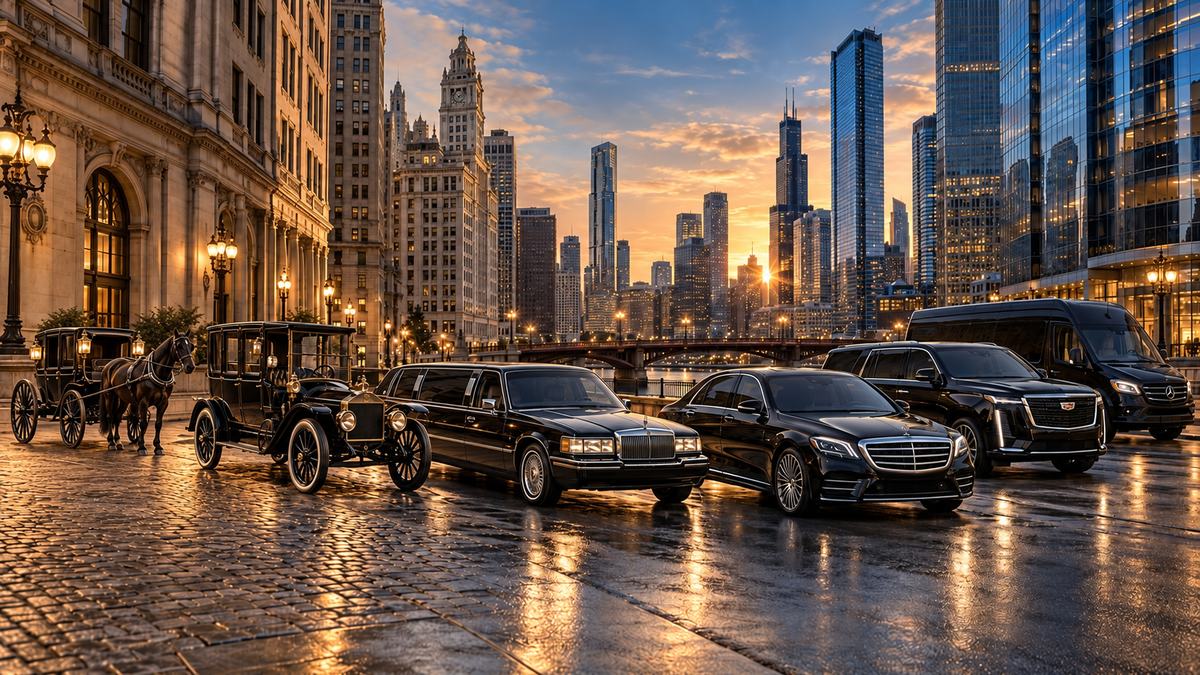
The history of the limousine begins long before stretch cars, tinted windows, celebrity arrivals and red-carpet events. Its roots reach back to the era of horse-drawn carriages, when wealthy passengers rode inside an enclosed compartment while the coachman remained outside. When automobiles arrived at the beginning of the 20th century, that same idea carried over: the passenger rode in privacy and comfort while a professional chauffeur handled the road.
Over more than a century, the limousine changed dramatically. It evolved from a formal automobile body style into a symbol of luxury, then into stretched vehicles for groups, airport transfers and entertainment, and eventually into the broader chauffeured transportation industry we know today.
Quick answer: The history of the limousine does not begin with one person suddenly inventing a long car. The word comes from the French region of Limousin, and the automobile meaning was in use by 1902. Early limousines placed passengers in an enclosed compartment while the chauffeur sat separately. By 1916, the Society of Automobile Engineers had formally defined the limousine as a distinct body style. Armbruster in Fort Smith, Arkansas, became an important pioneer of stretched professional vehicles during the 1920s. Over time, limousines expanded from private luxury cars into airport vehicles, executive transportation, wedding cars, stretch limos, black cars, SUVs and modern Sprinter-based group transportation.
The History of the Limousine Begins Before the Automobile
To understand where the limousine came from, start with the carriage.
For centuries, affluent travelers could hire or own carriages that separated the passengers from the person controlling the horses. The occupants sat inside a protected cabin while the coachman sat outside, exposed to weather and road conditions. That arrangement communicated more than comfort. It separated the passenger experience from the work of driving.
When automobiles began replacing horse-drawn transportation, wealthy owners did not necessarily want to give up that arrangement. Early luxury motorcars therefore borrowed ideas from carriage design. One of those ideas was a separate passenger compartment with a chauffeur positioned forward of it.
That separation between professional driver and passenger would become one of the defining ideas behind the limousine.
Where Did the Word “Limousine” Come From?
The name comes from Limousin, a region in central France.
The exact path from the regional name to the vehicle is not completely certain. One long-standing explanation is that the roof or covered driver’s area of an early limousine resembled the raised hood of a cloak associated with people from Limousin. Another explanation is that early chauffeurs wore a Limousin-style cloak while sitting in an exposed driving position.
The important point is that the name originally described a body style and arrangement, not an extra-long automobile.
That is very different from the image many people have today. For an early motorist, “limousine” could mean a formal closed passenger car with a separate chauffeur area. Length was not the defining feature.
Did Someone Invent the First Limousine?
There is no well-established single inventor who can accurately be called “the inventor of the limousine.”
That is one of the most repeated oversimplifications in limousine history.
Automobile terminology from the early 1900s developed as carriage makers, automobile manufacturers and coachbuilders experimented with different body designs. The word “limousine” is recorded in the automobile sense by 1902, describing an enclosed automobile associated with a separate or open chauffeur position.
That does not mean historians can point to one specific 1902 car and say, with certainty, “this person invented the limousine on this day.”
A more accurate way to understand the beginning is that the limousine evolved from carriage traditions into an early automobile body style.
What Did the First Motor Limousines Look Like?
They looked nothing like the extremely long stretch limousines that became famous decades later.
The passenger compartment was enclosed for comfort and privacy. The chauffeur sat in front, and on some early designs the driver’s position was partly or fully exposed to the weather. The overall vehicle could still be relatively compact by later limousine standards.
The design reflected the social structure of chauffeur-driven motoring at the time. The person paying for or owning the vehicle rode in the protected rear compartment. The chauffeur’s role was to operate and manage the automobile.
Privacy, separation and professional driving were central to the concept from the beginning.
By 1916, “Limousine” Had an Official Automotive Meaning
By the middle of the 1910s, automobile design had developed enough that industry organizations were trying to standardize the confusing number of body-style names.
In 1916, the Society of Automobile Engineers defined a limousine as a closed car carrying several passengers inside while the driver’s seat remained outside under a roof. Related categories included the berline, where the driver’s position was fully enclosed, and the brougham, where the driver’s seat had no roof.
Those definitions tell us something important: a limousine was already recognized as a distinct type of automobile well before the modern stretch era.
It was about passenger accommodation and chauffeur separation—not simply adding feet of steel between the front and rear wheels.
Why Were Early Limousines Associated With Wealth?
Automobiles themselves were expensive in the early 20th century. A vehicle designed to be driven by a hired chauffeur added another layer of expense and status.
The passenger was not simply buying transportation. The owner was paying for the automobile, its maintenance and a professional to operate it.
That helped connect limousines with wealthy families, business leaders, hotels, dignitaries and formal occasions. By the 1930s, the word had become strongly associated in American English with luxury automobiles.
The chauffeur also became part of the experience. Professional appearance, discretion, door service and knowledge of the route were features of a private-car experience long before GPS, airport apps or online reservations existed.
That tradition still survives in modern Chicago chauffeur service, even though today’s vehicles and technology are completely different.
The History of the Limousine Changes With the Stretch Car
The next major transformation came when coachbuilders began lengthening automobiles to carry more passengers.
Armbruster of Fort Smith, Arkansas, is one of the most important names in this part of the story. The company’s history says a bus operator asked whether an ordinary automobile could be stretched for professional short-distance passenger runs. Armbruster accepted the challenge and credits that work with producing the first combustion-engine limousine of its kind.
The exact year is described differently across historical accounts. Some histories trace Armbruster’s early stretched-vehicle work to the early 1920s, while 1928 is frequently cited as the point when the recognizable stretch limousine emerged.
Because those accounts vary, it is more accurate to say that Armbruster pioneered stretched professional automobiles in the 1920s than to pretend there is one undisputed invention date.
Why Were Cars Stretched in the First Place?
The original reason was practical: carry more people in a vehicle smaller and more flexible than a full-size bus.
That is an important part of the story because it changes the popular image of the stretch limo.
The earliest stretched vehicles were not invented primarily so people could celebrate birthdays with colored lights and a bar. They addressed professional passenger-transportation needs.
Hotels, transportation companies, tour operators and other businesses needed ways to move groups efficiently. Extending a passenger car created additional seating while preserving much of the automobile experience.
The modern idea of selecting a vehicle according to the passenger count has much older roots than most travelers realize.
Where Do the Famous “Big Band Buses” Fit In?
Touring musicians became one of the best-known early uses of extended automobiles.
Historical accounts often connect long professional cars with big bands and their equipment during the late 1920s and 1930s. That association helped give stretched vehicles a glamorous image because musicians and entertainers were visible public figures traveling from performance to performance.
These vehicles are sometimes described as “big band buses.”
However, band transportation is better understood as an important early use rather than the sole reason stretched automobiles were developed. Armbruster’s own history emphasizes professional short-run passenger transportation as the original challenge.
Over time, practical group transportation and entertainment culture helped push the stretched automobile in the same direction: longer vehicles carrying more passengers with a professional driver.
From Private Luxury Car to Airport Limousine
Another major chapter came with commercial aviation.
As air travel expanded, hotels, airlines and transportation operators needed vehicles capable of moving passengers between airports, hotels and city centers. Extended sedans and multi-door professional vehicles were well suited to that role.
By the mid-20th century, the term airport limousine could describe vehicles that were far more practical than the celebrity stretch limo people would later imagine. Some were long multi-passenger cars designed primarily to move travelers efficiently.
The word “limousine” was being used not only for the body shape of an automobile but increasingly for a professional passenger service.
That change helps explain why the term today can describe a chauffeured ride even when the vehicle is not stretched.
Cadillac, Lincoln and the American Limousine
As the American luxury-car market matured, Cadillac and Lincoln became deeply associated with professional cars and limousine conversions.
Coachbuilders used large luxury-car platforms because they offered the size, structure and formal appearance suited to chauffeur-driven transportation. Cadillac commercial chassis supported professional vehicle builders for decades, while Lincoln later became one of the most recognizable names in livery and stretch-limousine service.
By the 1980s, the Lincoln Town Car had become especially important to limousine builders. Its traditional rear-wheel-drive platform, formal shape and suitability for professional use helped make it a common foundation for both standard chauffeured sedans and stretched conversions.
For an entire generation, a black Lincoln Town Car became almost visual shorthand for professional car service.
The 1980s and 1990s Made the Stretch Limo a Pop-Culture Icon
The limousine’s public image changed again during the 1980s and 1990s.
Stretch vehicles became closely associated with celebrities, musicians, movie premieres, weddings, proms, nightlife and major celebrations. Coachbuilders offered increasingly elaborate interiors, including upgraded seating, privacy partitions, entertainment systems and specialty lighting.
The stretch limo became something people hired not only because they needed transportation, but because the vehicle itself was part of the occasion.
This is when the popular image of “a limo” and the technical meaning of “a limousine” began to separate dramatically.
To the general public, the longer the vehicle looked, the more clearly it read as a limousine.
Weddings Helped Preserve the Formal Limousine Tradition
While stretch limousines became entertainment icons, formal chauffeured cars remained closely connected with weddings.
That connection makes historical sense. Before automobiles, formal carriages were already used for ceremonial travel. The limousine simply carried that tradition into the motor age.
Couples could use an elegant sedan for the bride or newlyweds while the wedding party traveled separately in a stretch vehicle or larger group vehicle. That same division still exists in modern Chicago wedding limo service: the most appropriate vehicle depends on who is traveling and what role the vehicle has in the event.
The tradition changed vehicles, but the idea of formal professionally driven transportation remained.
The Lincoln Town Car Era Changed Professional Transportation
One of the biggest shifts in the history of the limousine came when the Lincoln Town Car became a workhorse of the American livery business.
The Town Car served two worlds at once. In standard form, it was a discreet chauffeur-driven sedan for airports, executives and private clients. In modified form, it could become the long stretch limousine associated with weddings, proms and entertainment.
That versatility mattered.
Professional operators could offer quiet business transportation and special-event limousine service while still working within a recognizable luxury-car family.
The Town Car remained deeply connected with chauffeured transportation until production ended in 2011, and its disappearance helped accelerate a broader change already underway in the industry.
Why Did SUVs Become So Important?
Passenger expectations changed.
Business travelers increasingly wanted discreet transportation rather than an attention-grabbing stretch vehicle. Families wanted more luggage room. Executives valued privacy, easy entry and space. Travelers heading to airports needed vehicles capable of handling several passengers and suitcases without sacrificing a professional appearance.
Large luxury SUVs fit those needs extremely well.
Vehicles such as the Cadillac Escalade and Lincoln Navigator helped redefine what premium chauffeured transportation looked like. Instead of a long body and rear-facing seats, modern luxury could mean a quiet black SUV, comfortable rear seating, luggage room and a professional chauffeur.
That development is reflected in today’s Chicago black car service, where premium sedans and SUVs serve many of the trips that earlier generations would simply have called limousine service.
The Sprinter Changed Group Limousine Service Again
The Mercedes-Benz Sprinter introduced another major change.
Traditional stretch limousines can create a memorable celebration experience, but a Sprinter gives groups a different combination of passenger room, cabin height, luggage capability and seating configurations.
That made the platform useful far beyond parties. Sprinter vehicles became common for corporate groups, airport transfers, weddings, roadshows, events and private group travel.
Modern Sprinter limo service shows how far the original concept has evolved. The vehicle is not shaped like the classic limousine of 1916 and does not resemble a Lincoln stretch from the 1990s, yet it serves the same underlying purpose: professionally driven private transportation designed around passenger comfort and the needs of the trip.
What Does “Limousine” Mean Today?
Today, the word has several meanings depending on context.
It can still refer to a formal luxury automobile with a chauffeur and passenger separation. It can describe a stretched sedan. It can be shorthand for a special-event vehicle. And in the United States, “limo service” commonly refers more broadly to prearranged chauffeured transportation.
That broader meaning includes executive sedans, Mercedes-Benz S-Class vehicles, Cadillac Escalades, Lincoln Navigators, Sprinter vans and traditional stretch limousines.
A modern luxury vehicle fleet therefore looks much more diverse than a limousine fleet from several decades ago.
The industry did not abandon the limousine. It expanded the idea.
From Separation to Service: What Never Changed
The vehicles changed repeatedly, but several principles survived.
The original limousine separated the passenger from the work of driving. Today’s chauffeur service does the same in a modern way. The passenger does not have to navigate traffic, find parking, manage curbside logistics or focus on the road.
The original limousine emphasized privacy. Modern executive sedans and SUVs continue to prioritize private passenger space.
The original limousine relied on a professional chauffeur. That distinction remains central.
Even point-to-point limo service carries part of that original philosophy: the passenger reserves the trip in advance, the vehicle is assigned to the journey, and a professional handles transportation from pickup to destination.
Technology changed the mechanics. The service principle remained surprisingly recognizable.
How Limousine Booking Changed
Early limousine ownership was largely private. Wealthy households or institutions employed chauffeurs and maintained vehicles themselves.
Commercial limousine companies expanded access. Instead of owning a luxury vehicle and hiring a chauffeur full-time, customers could reserve professional transportation only when needed.
Telephone dispatch eventually gave way to computerized reservations, flight tracking, GPS and online booking. Customers can now reserve a chauffeur for a direct transfer, an airport arrival, a wedding, a corporate itinerary or several hours of flexible transportation.
Modern hourly limo service is in some ways a contemporary version of having a chauffeur and car at your disposal—without owning either one.
A Short Limousine History Timeline
The limousine’s evolution can be summarized through a few important milestones:
- Before automobiles: enclosed passenger carriages establish the separation between passenger and coachman.
- 1902: the word “limousine” is recorded in English for an automobile body style with an enclosed passenger area and separate chauffeur position.
- 1916: the Society of Automobile Engineers formally defines the limousine as a distinct automobile body type.
- 1920s: Armbruster in Fort Smith, Arkansas, pioneers stretched professional passenger vehicles; later accounts frequently associate 1928 with the emergence of the recognizable stretch limousine.
- 1930s: “limousine” becomes increasingly associated with luxury in American usage.
- Mid-20th century: airport, hotel, tour and institutional transportation expands the role of extended professional vehicles.
- 1980s–1990s: Lincoln, Cadillac and coachbuilt stretch limousines become major symbols of executive travel, weddings, celebrities and celebrations.
- 2000s onward: luxury SUVs, executive sedans and Sprinter vehicles become increasingly important to chauffeured transportation alongside traditional stretches.
- Today: limousine service can mean a professionally chauffeured sedan, SUV, stretch limousine, Sprinter or other premium vehicle selected for the trip.
Is a Limousine Still a Limousine If It Is Not Stretched?
Yes—especially when talking about limousine service rather than one specific vehicle body type.
The historical record itself makes this clear. The limousine existed decades before the familiar modern stretch limo.
The stretch limousine is one branch of limousine history, not the beginning of it.
That is why someone booking a Chicago limo service today may ride in an S-Class, Escalade, Navigator, Sprinter or stretch vehicle depending on the trip.
The common thread is professionally arranged chauffeur transportation.
Frequently Asked Questions
Who invented the limousine?
There is no universally documented single inventor of the original limousine. The automobile body style evolved from earlier chauffeur-driven carriage traditions. The term was already being used for automobiles by 1902.
When was the first limousine made?
The automobile meaning of “limousine” is recorded from 1902, but it is more accurate to treat that as the emergence of the automobile body style rather than an unquestioned invention date for one specific vehicle.
Where did the name limousine come from?
The word comes from Limousin, a region of France. The exact reason the regional name became attached to the vehicle is debated, with explanations involving either the shape of a traditional hooded cloak or clothing used by early chauffeurs.
What were early limousines used for?
Early motor limousines were primarily associated with private chauffeur-driven transportation. They gave passengers an enclosed, protected compartment while separating them from the chauffeur.
Who invented the stretch limousine?
Armbruster of Fort Smith, Arkansas, is widely credited with pioneering stretched professional automobiles during the 1920s. Historical accounts differ on the exact year, with early-1920s work and 1928 both appearing in published histories.
Why were stretch limousines originally made?
Early stretched vehicles addressed practical passenger-capacity needs. They were used for professional short-distance transportation and later became associated with touring bands, hotels, airports and group travel.
Why did Lincoln Town Cars become so common as limousines?
The Town Car combined a formal luxury appearance with a durable rear-wheel-drive platform that worked well for professional livery service and coachbuilt stretch conversions.
Are stretch limousines still used today?
Yes. They remain popular for weddings, proms, milestone celebrations and special events, although modern chauffeured fleets also rely heavily on luxury sedans, SUVs and Sprinters.
What is the difference between a chauffeur service and a stretch limo?
A stretch limo describes a type of vehicle. Chauffeur service describes the professional transportation service itself. A chauffeur may drive a luxury sedan, SUV, Sprinter or stretch limousine depending on the reservation.
Why the History of the Limousine Still Matters Today
The history of the limousine is really a history of how people have defined private, professional transportation.
The earliest limousines separated the passenger from the chauffeur. Stretch vehicles expanded capacity. Airport limousines moved travelers between terminals and cities. Lincoln and Cadillac helped define American luxury transportation. Stretch conversions turned the limousine into a cultural symbol. SUVs and Sprinters later changed the shape of the industry again.
What survived every transition was the basic idea: a passenger reserves a vehicle and relies on a professional to handle the journey.
That is why a modern limousine does not have to be extraordinarily long to continue the tradition. An executive sedan traveling to a Chicago meeting, an Escalade collecting a family from O’Hare, a Sprinter carrying a corporate group and a stretch limo arriving at a wedding are all different branches of the same transportation history.
To reserve modern chauffeured transportation in Chicago, call (866) 666-0112 or contact the reservations team.
Level Up Limo
707 Skokie Blvd #600, Northbrook, IL 60062
100 S. Saunders Rd Suite 150, Lake Forest, IL 60045
Phone/Text: (866) 666-0112
Reservations: 24/7